
Gold School · Episode 3
Every big gold crash, and why it happened
Seven crashes, from 1975 to 2026: how far gold fell, how long it took to recover, and what they have in common. History only. 8 min 36.
The video plays from YouTube when you tap it. Open on YouTube · Our channel
In this lesson
Tap a part to jump to it.
 Gold's 28-year wait0:00
 What counts as a crash0:18
 Crash 1: 1975 to 19760:35
 Crash 2: 1980 to 19821:27Read the guide →
 Crash 3: the long slide to 19992:17
 Crash 4: 20083:24
 Crash 5: 2011 to 20154:18
 Crash 6: 2020 to 20225:05
 Crash 7: 20265:47
 How long gold took to recover6:26
 What the crashes have in common6:53Read the guide →
 Is gold a safe haven?7:49
The words
Rather read? Here is the lesson in words.
0:00 Gold's 28-year wait
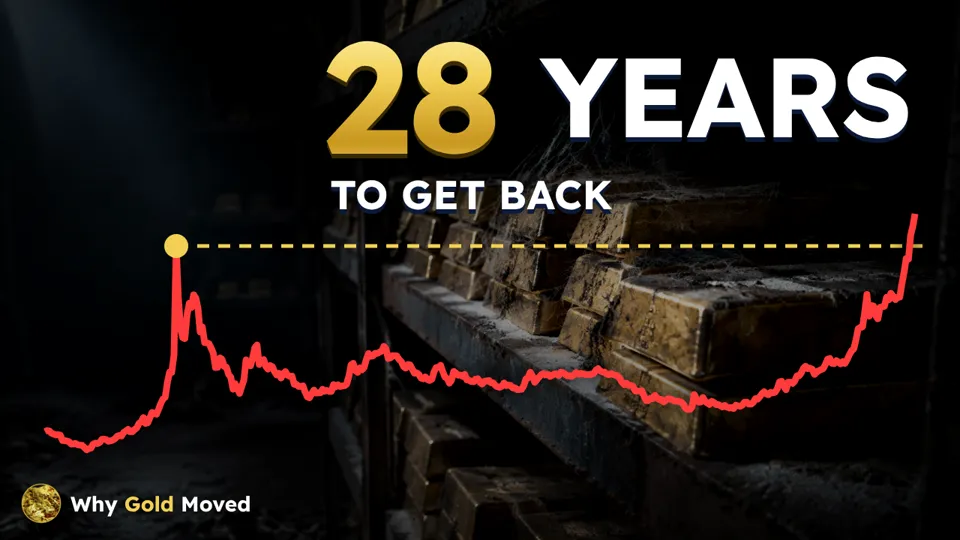
In January 1980, gold hit 850 dollars an ounce. It did not see that price again for nearly 28 years.
Gold is called a safe haven. Yet it has crashed at least six times in fifty years.
Here is every one, and why.
0:18 What counts as a crash
First, what counts. A crash here means gold fell by about a fifth or more from a high.
Some took weeks. One took twenty years.
This is history, not a forecast. Nobody here is telling you what gold does next.
Let's start in 1975.
0:35 Crash 1: 1975 to 1976
Crash one. For more than forty years, Americans had been banned from owning gold bars. That ban ended on the last day of 1974.
Traders expected a rush of new buyers, and bought ahead of it. Gold reached about 195 dollars an ounce, a record at the time.
Then the rush did not come. Worse, within a week the US Treasury began selling gold at auction. In 1976 the International Monetary Fund started selling too.
By the end of August 1976, gold was near 103 dollars. It had lost almost half its value in twenty months.
Newspapers called it the great gold bust. Plenty of people thought gold was finished.
It was not. But remember the shape of this one: a price that rose on a story, and fell when the story arrived.
1:27 Crash 2: 1980 to 1982
Crash two is the famous one.
By the end of the 1970s, US inflation was running at about 13 percent. Then the Soviet Union invaded Afghanistan. People piled into gold.
From that low of 103 dollars, it climbed to 850 in under four years. The peak came on the 21st of January 1980.
The very next day, gold fell 13 percent.
What ended the party was interest rates. The Federal Reserve, led by Paul Volcker, pushed US rates to about 20 percent to break inflation.
Think about what that means. Cash and bonds were suddenly paying well into double figures. Gold pays nothing.
By the middle of 1982, gold was close to 300 dollars. Down about 65 percent from the peak.
2:17 Crash 3: the long slide to 1999
Crash three was slow. It lasted most of twenty years.
It did not fall in a straight line. Gold bounced back to about 500 dollars at the start of 1983. Then, in two days that February, it dropped 14 percent. By early 1985 it was under 300 dollars again.
Through the 1980s and the 1990s, inflation stayed low, the dollar was strong, and shares boomed. Gold drifted lower, year after year.
Central banks began to treat it as dead money, and some of them sold.
In May 1999, the United Kingdom said it would sell about half of its gold reserves. In the end it sold 395 tonnes.
That July, gold touched about 253 dollars. Seventy percent below the 1980 peak, nearly two decades later.
The turn came in September 1999, when European central banks agreed to limit how much gold they would sell each year.
And that 850 dollar high from 1980? Gold did not pass it again until 2008.
3:24 Crash 4: 2008
Crash four. 2008. This one surprises people, because it happened in the middle of a financial crisis.
In March 2008, days after the emergency rescue of the bank Bear Stearns, gold passed 1,000 dollars for the first time. Then, in September, Lehman Brothers collapsed.
You would expect a safe haven to soar. Instead, by late October, gold was near 712 dollars. Down about 30 percent in seven months.
Why? Because in a real panic, people sell whatever they can to raise cash. Gold was one of the few things still worth selling.
But look at what came next. Within three years, gold had more than doubled, to a record above 1,900 dollars.
So 2008 is the crash that did not last. The fall was fast, and so was the recovery.
4:18 Crash 5: 2011 to 2015
Crash five. Gold had risen every single year since 2001. It peaked at about 1,920 dollars in September 2011.
Then the fear faded. Inflation stayed low. And in 2013 the Fed signalled it would start to wind down its support for the economy.
Money poured out of gold funds.
On Monday the 15th of April 2013, gold fell 9 percent in a single day. It was the biggest one-day fall in thirty years. Over two trading days, it lost about 13 percent: more than 200 dollars an ounce.
The slide went on until the end of 2015, when gold bottomed near 1,050 dollars. Down about 45 percent from the top.
5:05 Crash 6: 2020 to 2022
Crash six. In August 2020, during the pandemic, gold set a new record near 2,070 dollars.
Then inflation took off. In February 2022, Russia invaded Ukraine, and gold jumped back towards its record. You might think all of that helps gold.
But the Fed answered with its fastest rate rises in forty years: from near zero in March 2022 to about 4 percent by November. The dollar hit a twenty-year high.
Gold fell for most of that year, to about 1,615 dollars. Down just over a fifth.
Smaller than the others. But the same cause as 1980: higher interest rates.
5:47 Crash 7: 2026
And crash seven is happening as this video is made.
On the 28th of January 2026, gold closed at a record of about 5,420 dollars.
Then oil prices jumped, US inflation rose, and markets began to expect the Fed to raise interest rates again.
On the 30th of October, gold fell to about 3,876 dollars, its lowest in a year. Down about 28 percent from the record. It was gold's worst October since 2008.
Where it goes from here, nobody knows. And that is not what this video is for.
6:26 How long gold took to recover
How long did it take to get back to the old high each time?
After the 1974 peak, three and a half years.
After March 2008, gold was back the following year.
After the 2020 record, a little over three years.
After 2011, nearly nine years.
And after 1980, nearly 28.
So the wait has been anything from one year to a whole generation.
6:53 What the crashes have in common
So what do seven crashes have in common? Five things.
One. Rising US interest rates. Gold pays no interest, so when rates climb, it has more to compete with. That was 1980, 2013, 2022 and 2026.
Two. A strong dollar. Gold is priced in dollars, so a stronger dollar is usually negative for gold.
Three. Forced selling. In a panic like 2008, gold gets sold for cash, at least at first.
Four. Big sellers. Governments and central banks, in 1975 and again in 1999.
And five. Every one of these crashes came straight after a huge run-up. The higher the climb, the further there was to fall.
Notice what is not on that list. Scary headlines. In 1980 and in 2026 there was plenty of frightening news, and gold still fell.
7:49 Is gold a safe haven?
So is gold a safe haven?
Over many years, every peak before this year's was passed in the end. One of them took nearly 28 years.
But along the way, gold has fallen by a third, by half, and once by 70 percent.
Gold doesn't always react the same way. That is exactly why it is worth understanding the why.
Education only. Gold doesn't always react the same way. Not financial advice.
Keep going
Read each idea as a short lesson.
- 1What moves the price of gold?▶ 6-minute video + 2 min read · The five big drivers, in one page. Start here.
- 2Why does a weaker dollar help gold?▶ 1-minute video + 2 min read · The dollar see-saw, and why euro and pound news matters too.
- 3Why does gold fall when interest rates rise?▶ 1-minute video + 2 min read · Why gold and interest rates usually move in opposite directions.
- 4Does CPI affect gold?▶ 1-minute video + 2 min read · US inflation data, and why cooler numbers usually help gold.
Free · no sign-up
Keep up with the news that moves gold most
A reminder before every big release, then why gold moved, in plain English, the moment the news lands.
- 📅 Reminders in your time zone
- 🟢 🔴 Good or bad for gold
- 💬 The why, in one line
Free gold news on Telegram.