
Gold market explained · updated 6 October 2026
Why is gold falling? Who's selling, and who's still buying
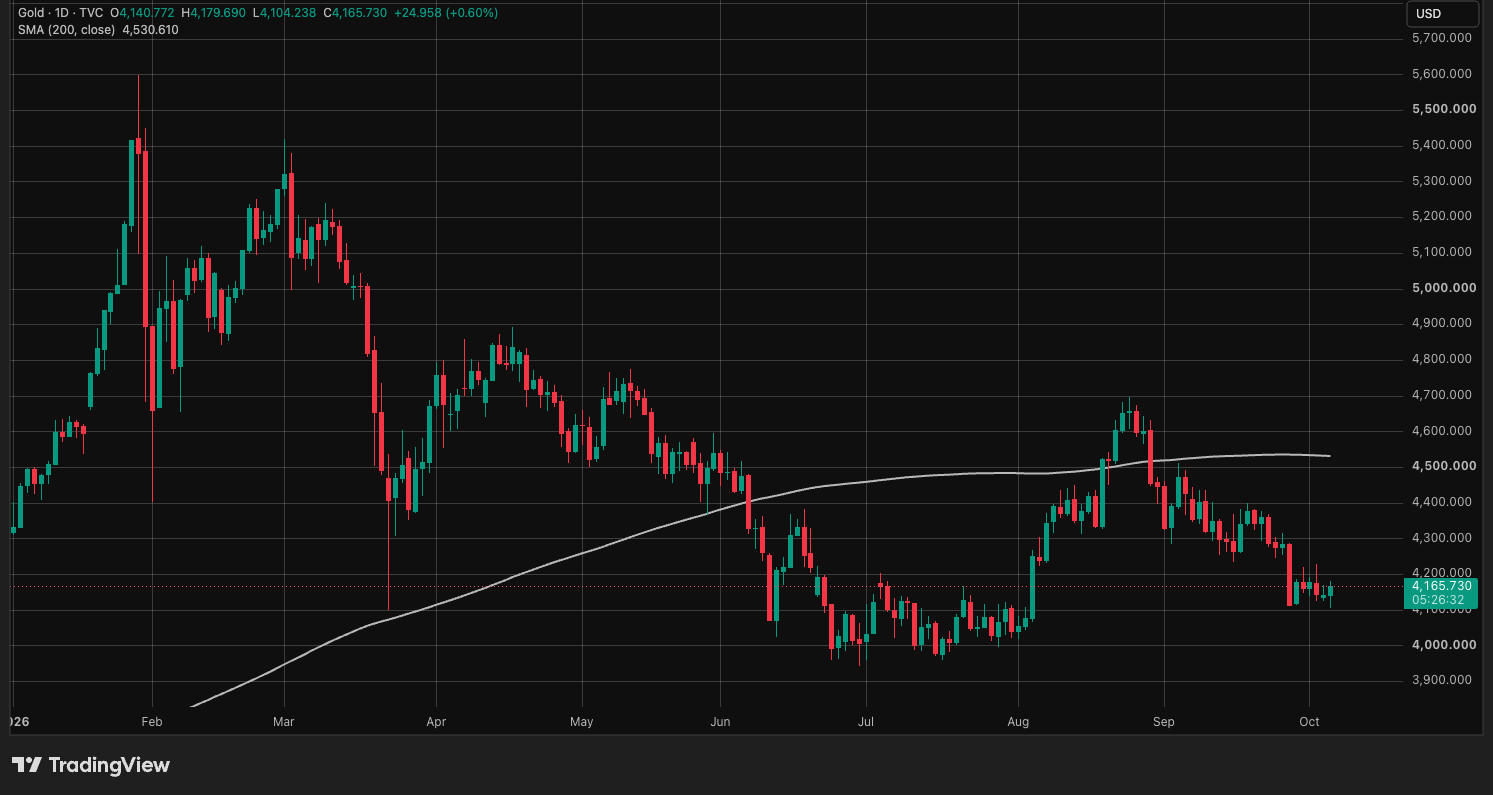
Gold is about 26% below its January record. After a bounce in the summer, many expected new highs. Instead it has been slowly sliding. Here's who has been buying and selling, and why.
Right now (6 Oct): gold dropped to about $4,100 overnight, then bounced as high as about $4,178 on a day of bad news. That is what you would expect when the selling is running out. Below: who sold, and who is still buying.
The short answer
Gold in 2026 so far
| When | What happened |
|---|---|
| 29 Jan | All-time high about $5,600 |
| March | War with Iran, oil jumps. Gold's worst month since 2008 down 12% to 13% |
| Mid-July | Low of the year about $3,945 |
| 24 Aug | The summer bounce peaks, highest since May about $4,635 |
| 28 Aug | Fed chair Kevin Warsh sounds tough on inflation at Jackson Hole down about $70 in 10 minutes |
| 16 Sep | The Fed raises interest rates, its first rise since 2023 about $4,355 |
| 6 Oct | Low overnight, then a bounce on bad news about $4,100 to $4,178 |
Spot gold, US dollars per ounce. Sources give the record as $5,586 to $5,608 and the July low as $3,941 to $3,950, so these are rounded. See gold price history.
Why the bounce faded: rates went up
Gold pays no interest. When safe US government bonds pay more, holding gold costs you that interest. So gold usually struggles when rates rise. Why rates matter for gold.
| Measure | Why it matters |
|---|---|
| Fed interest rate 3.75% to 4.00% | Raised on 16 Sep. 12 of 18 Fed officials expect one more rise in 2026. |
| US 10-year bond yield 5.35% | On 5 Oct, the highest since April 2002. |
| Yield after inflation 2.65% | At a 17 Sep auction, the highest in about 18 years. This matters most for gold. |
| The dollar (index) 102.5 | On 5 Oct, an 18-month high. A strong dollar makes gold dearer for everyone else. |
Weak US jobs data on 2 October (29,000 new jobs against about 89,000 expected) gave gold a lift, but it faded within hours as yields and the dollar stayed high. How gold reacted to every release this year.
Who's selling: hedge funds
Every week, the US regulator publishes who holds bets on gold in the futures market (the Commitments of Traders report). The group to watch is "managed money": hedge funds and other fast-moving funds. The number below is their net bets on higher gold, in contracts (each contract is 100 ounces).
- They bought the bounce. From the July low to 25 August, hedge funds raised their net bets on higher gold by about 20%, to the highest of 2026.
- The trade got crowded. By late August, speculators held one of their biggest shares of the gold futures market since 2018. When nearly everyone is already in, there are few new buyers left.
- Then they started leaving, slowly. Five weeks of cuts in a row took their bets down about 17%, back to where they were at the July low.
Who's on the other side? Mostly banks ("swap dealers"). They make the market and are usually net short when funds are net long, so their position is not a bet on gold falling.
Who's still buying: central banks and gold funds
| Buyer | What they did |
|---|---|
| Central banks | Bought 289 tonnes in April to June. China added 20 tonnes in August, its 22nd month of buying in a row and its biggest buy since October 2023. Poland was the biggest buyer in the first half (82 tonnes). |
| Gold funds (ETFs) | A record 121 tonnes bought in August, taking holdings to a record 4,189 tonnes. US gold funds took in another $3.7 billion in September. |
| But not everyone | Central bank buying in the first half of 2026 was the lowest since 2022. Turkey (83 tonnes) and Russia (44 tonnes) sold. |
These are slow, steady buyers. They don't stop gold falling, but they soften it.
And everyday traders and savers?
- Small traders are more upbeat than the pros. In Kitco's survey on 2 October, 47% of the public expected gold to rise, against 23% of Wall Street analysts.
- Many retail traders are still betting on a rise. On one large trader community (6 October), about two thirds were positioned for higher gold, with an average entry near $4,408, above today's price.
- Households are cashing in. In India, people sold about 50 tonnes of old gold in April to June, 43% more than a year earlier. In China, jewellery buying fell 34% in the first half while bars and coins rose 28%.
Why a slow slide, not a crash?
| March 2026 | Now | |
|---|---|---|
| What happened | Forced selling: gold funds dumped about $12 billion and trend-following funds sold as key price averages broke | Hedge funds trimming week by week, while central banks and gold funds keep buying |
| Gold | Down 12% to 13% in one month | Down about 11% in six weeks from the August high |
A crash needs everyone selling at once. Right now the fast money is leaving, but the slow money is still coming in. That tug of war is why gold is bleeding rather than collapsing.
What could change the picture
We don't forecast prices. But in the past, gold's big turns have often come when markets started to expect interest-rate cuts instead of rises (see gold in every crash since 1987). These are the dates that move those expectations:
| When | What |
|---|---|
| Wed 7 Oct, 2pm New York (19:00 UK) | Notes from the Fed's September meeting |
| Wed 14 Oct, 8:30am New York (13:30 UK) | US inflation (CPI). Cooler than expected is usually 🟢 for gold, hotter 🔴 |
| Wed 28 Oct, 2pm New York (18:00 UK) | Fed interest-rate decision |
| Every Friday, 3:30pm New York | The hedge fund data (Commitments of Traders) |
Questions people ask
Why is gold going down?
Mainly because US interest rates are going up, not down. The Fed raised rates on 16 September 2026, US 10-year bond yields hit their highest since 2002, and the dollar hit an 18-month high. Gold pays no interest, so when safe bonds pay more, gold is less attractive. Hedge funds have been cutting their bets on higher gold for five weeks in a row.
Who is selling gold?
Mostly hedge funds and other fast-moving traders in the futures market. Their net bets on higher gold fell about 17% between 25 August and 29 September 2026. Some central banks (Turkey and Russia) also sold in the first half of 2026, and Indian households sold more old gold than a year earlier.
Who is still buying gold?
Central banks (they bought 289 tonnes in April to June 2026, with China adding gold for 22 months in a row) and gold funds (ETFs), which took in a record 121 tonnes in August. These slower buyers are a big reason gold has slid slowly instead of crashing.
Is gold in a bear market?
A common definition of a bear market is a fall of 20% or more from the high. On 6 October 2026 gold was about 26% below its January record, so it meets that definition. That describes the past. It does not tell you what gold does next.
When does the hedge fund data come out?
Every Friday at 3:30pm New York time (usually 20:30 UK), in the US regulator's Commitments of Traders report. It shows positions as of the Tuesday before.
Sources
- CFTC Commitments of Traders, COMEX gold (data API)
- World Gold Council: gold ETF flows, August 2026
- World Gold Council: central banks, Q2 2026
- World Gold Council: gold market commentary, March 2026
- Kitco: China's central bank buys 20.2 tonnes in August
- State Street: monthly gold monitor (US gold ETF flows)
- BullionVault: gold and Warsh at Jackson Hole, 28 Aug
- Yahoo / Reuters: gold hits over 3-month high, 24 Aug
- FXStreet: US dollar index at an 18-month high, 5 Oct
- Trading Economics: US 10-year yield
- Kitco: Wall Street and Main Street gold survey, 2 Oct
- FXEmpire: the crowded long, 31 Aug
Hedge fund figures: CFTC Disaggregated Commitments of Traders, COMEX gold, futures only, "managed money" net (long minus short), report dates as shown. We update this page monthly. Education only. Past patterns can change. Not financial advice.
Know why gold moved, within minutes
Every jobs report, inflation number and Fed decision, explained in plain English as it lands. Free.