
Gold market explained · updated 7 October 2026
Why are bond yields rising? Bonds and gold, explained
Government bonds are selling off around the world, and that is one of the biggest forces on gold right now. Here's how bonds work, why yields are rising, and why gold cares, in plain English.
The short answer
What is a bond?
A bond is an IOU (an "I owe you"). You lend a government (or a company) money. It pays you a fixed amount of interest every year, then pays the money back at the end.
| When | What happens |
|---|---|
| Today | You lend the US government $100 for 10 years |
| Every year | It pays you $5 (this never changes) |
| After 10 years | You get your $100 back |
US government bonds are called Treasuries. UK ones are called gilts. They are seen as some of the safest places to keep money, which is why gold is always compared with them.
Price down, yield up: the see-saw
Bonds are bought and sold every day, like shares. The $5 a year never changes, but the price people pay for the bond does. The yield is the yearly return at today's price.
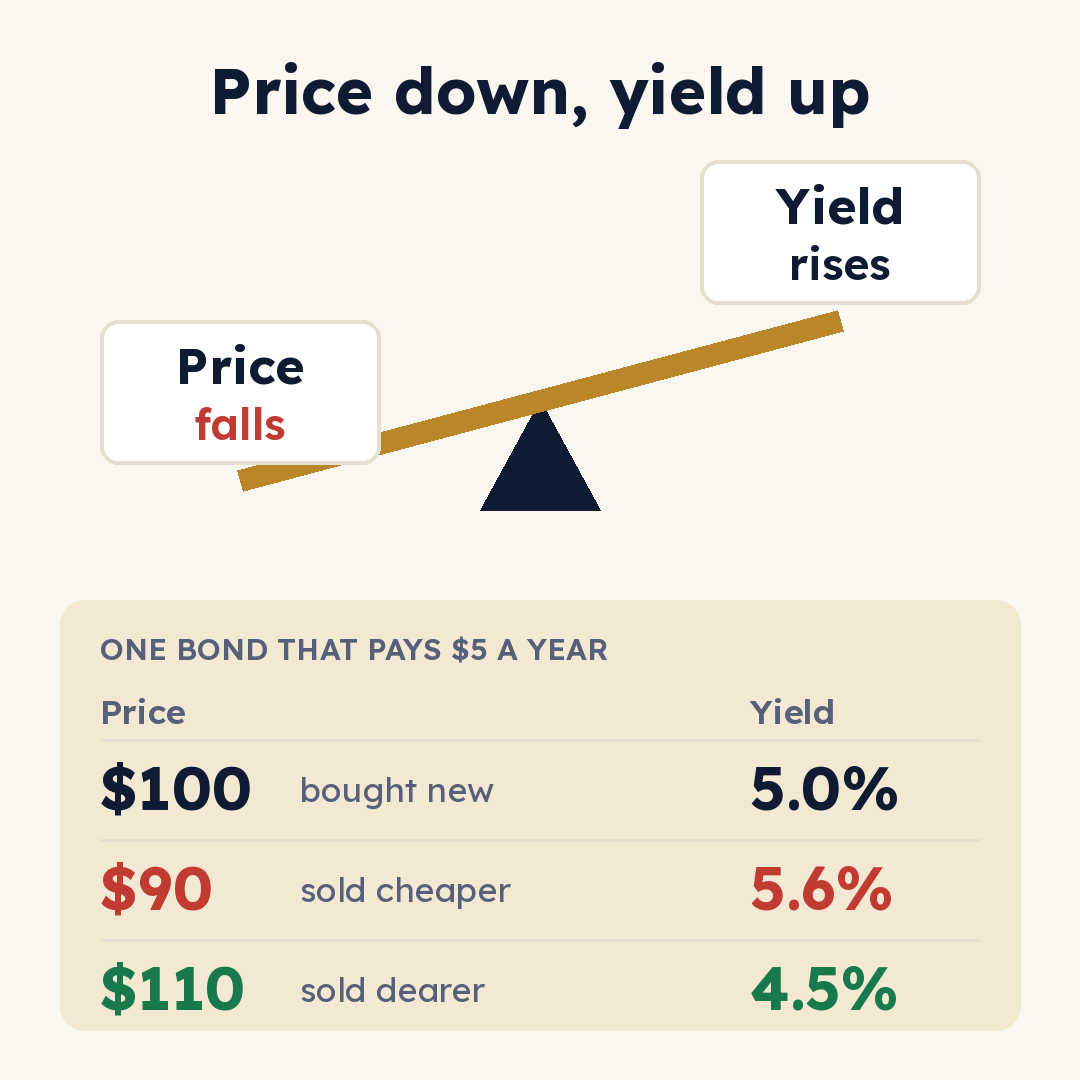
So "bonds are selling off" and "yields are rising" mean the same thing. When you see a headline about yields hitting a high, it means bond prices are falling.
Why are bond yields rising in 2026?
- Inflation fears. Oil climbed to about $100 a barrel after the war with Iran. Inflation eats into a fixed $5 a year, so buyers want a bigger yield to make up for it.
- Higher interest rates. The Federal Reserve (the Fed, the US central bank) raised US rates to 3.75% to 4.00% on 16 September 2026. When new bonds pay more, old ones have to get cheaper to compete.
- Too much borrowing. Governments are borrowing heavily, which means more new bonds to sell. Investors have pointed to deficit and borrowing worries as a reason to demand more.
- Selling feeds on itself. On 1 October, traders warned the US bond market was caught in a "vicious loop" of selling.
The US 10-year yield rose about 0.87 percentage points from July to September 2026, its steepest quarterly rise since 1994.
It's not just the US
| Bond | Early October 2026 |
|---|---|
| US 10-year | 5.34% Highest since 2002 (1 Oct) |
| US 30-year | About 5.7% 1 Oct intraday high: 5.68% |
| UK 30-year gilt | About 6% First time since 1998 |
| France 10-year | 4.96% Highest since 2002 |
| Japan 10-year | Above 3% First time since 1996 |
Bond markets pull each other up. When yields jump in one big country, investors elsewhere ask for more too.
Why bond yields move everything
Government bond yields are the base price of borrowing money. When they rise, almost everything else feels it.
| What | What higher yields usually do |
|---|---|
| Mortgages | Fixed-rate home loans get dearer |
| Companies | Borrowing costs more, which can squeeze company earnings |
| Shares | Safe bonds become real competition for stocks |
| The dollar | Higher US yields pull money into dollars, so the dollar tends to rise |
| Gold | Usually weighs on it (next section) |
Why rising yields usually hurt gold
Gold pays no interest. Every ounce you hold is money that could be earning a yield in a safe bond. When the US 10-year pays over 5%, that is a lot of interest to give up. Short guide: why bond yields matter for gold.
The number gold watches most is the real yield: the bond yield after inflation. It is what a bond really earns you. At a US government auction on 17 September 2026, the 10-year real yield was 2.65%, the highest in nearly 18 years.
Higher US yields also tend to lift the dollar, and a stronger dollar makes gold dearer for buyers using other currencies. So rising yields can hit gold twice. Why the dollar matters for gold.
When the rule broke
| When | What happened |
|---|---|
| 2005 to 2021 | Gold moved closely opposite to the real yield. One study puts the link at 84%. |
| 2022 to 2023 | Yields jumped, but gold held up. The link fell to about 3%. Central banks bought over 1,000 tonnes a year, double their 2010 to 2021 average. |
| 2026 | Yields at their highest since 2002, and gold about 26% below its January record of about $5,600 (gold price history). Who's selling gold in 2026. |
The lesson: bonds explain a lot about gold, not everything. When gold ignores yields, look at who else is buying or selling.
What to watch next
We don't forecast yields or gold. These are the dates that usually move US bond yields:
| When | What |
|---|---|
| Wed 7 Oct, 2pm New York (19:00 UK) | Notes from the Fed's September meeting |
| Wed 14 Oct, 8:30am New York (13:30 UK) | US inflation (CPI). Hotter than expected usually pushes yields up |
| Wed 28 Oct, 2pm New York (18:00 UK) | Fed interest-rate decision |
Questions people ask
What is a bond yield?
The yearly return you get on a bond at today's price (leaving out the money you get back at the end). A bond that pays $5 a year and costs $100 yields 5%. If its price falls to $90, the same $5 is a 5.6% yield.
Why do bond yields go up when prices fall?
Because the payments are fixed. A bond pays the same amount whatever it costs. If you pay less for it, that same payment is a bigger return on your money, so the yield is higher.
Why are bond yields rising in 2026?
Three reasons come up again and again: fear of inflation (oil near $100 after the Iran war), higher interest rates (the Federal Reserve, the US central bank, raised rates on 16 September), and heavy government borrowing, which means more bonds to sell. In early October the US 10-year yield hit 5.34%, the highest since 2002.
Do higher bond yields always hurt gold?
Not always. Higher yields usually weigh on gold, because gold pays no interest. But in 2022 and 2023 yields rose fast and gold held up, because central banks bought huge amounts, over 1,000 tonnes a year. Yields are one force on gold, not the only one.
What is a real yield?
The bond yield minus inflation. It is what a bond really earns you. It matters most for gold. At a US government auction on 17 September 2026, the 10-year real yield was 2.65%, the highest in nearly 18 years.
Sources
- Irish Times: global bond sell-off pushes 10-year Treasury yield to highest since 2002, 1 Oct
- Vantage Markets: global bond rout, US 10-year at a 2002 high, 5 Oct
- TIPSwatch: 10-year TIPS real yield of 2.653%, highest in nearly 18 years, 17 Sep
- RBC Wealth Management: gold's regime change (gold and real yields)
- Kiplinger: September 2026 Fed meeting
- Trading Economics: US 10-year yield
Yields are market levels on the dates shown and change every day. Education only. Gold doesn't always react the same way. Not financial advice.
Know why gold moved, within minutes
Every jobs report, inflation number and Fed decision, explained in plain English as it lands. Free.